Skip to content
FonteumThe Graph
DataResearchCare CompareThe DifferAttestAPI
See the proof
  • Data
  • Research
  • Care Compare
  • The Differ
  • Attest
  • API
See the proof

Fonteum · Learn · Healthcare policy & data explainers

Learn: healthcare policy and data, explained from the source

Plain-language explainers for US healthcare policy and federal data. Each guide answers the question completely, cites the primary CMS and federal sources, and links to the underlying facility-level data with per-field provenance. The inaugural cluster covers hospital-acquired conditions and the CMS HAC Reduction Program.

Reviewed by Jennifer Montecillo, MD, medical reviewer. Non-practicing medical reviewer.Last reviewed: June 2026 · Next review: December 2026 · Data last updated: 2026-06-03About our reviewers →
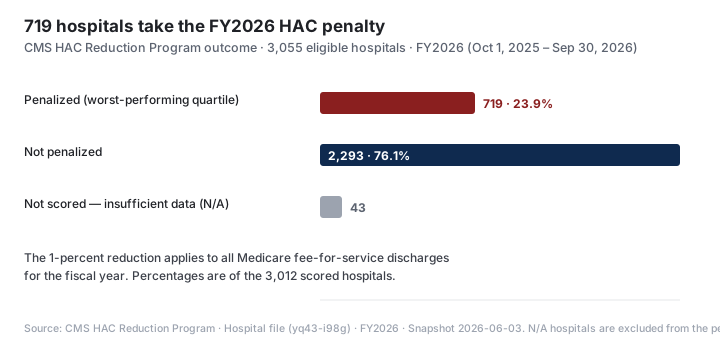
Bar chart: FY2026 CMS HAC Reduction Program outcome across 3,055 eligible hospitals — 719 hospitals (23.9% of the 3,012 scored) in the worst-performing quartile take a 1-percent Medicare payment reduction, 2,293 are not penalized, and 43 had insufficient data to be scored.
The Learn hub's flagship topic — source: CMS HAC Reduction Program · Hospital file (data.cms.gov) · FY2026 · snapshot 2026-06-03.
HAC explainerHAC penalty dataResearch indexHospital cost reportsData sourcesMethodology
Primary federal sources:CMS data.cms.gov ↗CMS cms.gov ↗AHRQ ahrq.gov ↗

Explainers

CMS HAC Program
Hospital-Acquired Conditions

What hospital-acquired conditions are, the 14 CMS categories under the Deficit Reduction Act of 2005, and how the HAC Reduction Program penalizes the worst-performing quartile of hospitals. FY2026 data for 3,055 hospitals.

Read →
Research data
HAC Reduction Program Penalties (Data)

Facility-level FY2026 penalty status and Total HAC Scores, rolled up by state — 719 of 3,012 scored hospitals take the 1-percent Medicare payment reduction. Companion data page to the explainer.

Read →
CMS PBJ Staffing
Nursing Home Staffing Levels

How CMS measures nursing home staffing via the mandatory Payroll-Based Journal (PBJ), the published federal RN hours-per-resident-day benchmark, and where to find county-level staffing data across thousands of US nursing home facilities.

Read →
CMS Enforcement
Nursing Home Payment Denials (DPNA)

What a Denial of Payment for New Admissions is, how CMS imposes it, how long bans typically last, and which states have the most enforcement actions — with data from the CMS NH Penalties file.

Read →
NPI / NPPES
What Is an NPI Number?

A complete explanation of the National Provider Identifier — what it is, the difference between Type 1 and Type 2 NPIs, how the 10-digit structure works, and how to look up any provider in the federal NPPES registry.

Read →
NPI / NPPES
NPI Meaning — What NPI Stands For

NPI stands for National Provider Identifier. This guide breaks down each letter of the acronym, explains the digit structure, and shows how the NPI compares to the DEA number, UPIN, and other provider IDs.

Read →
NPI / NPPES
How to Check an NPI

A step-by-step guide to looking up and checking any NPI in the NPPES registry — what fields to examine, red flags that signal an invalid or misused number, and when a deeper credential check is warranted.

Read →

More explainers are added as Fonteum publishes new federal-data topics. Browse the research studies and the hospital cost report data for the underlying datasets.

Frequently asked questions

What is the Fonteum Learn hub?
The Learn hub is Fonteum's library of plain-language explainers for US healthcare policy and federal data. Each explainer answers a definitional question completely, cites the primary federal sources, and links to the underlying facility-level data so any figure can be traced to its origin. The inaugural cluster covers hospital-acquired conditions and the CMS HAC Reduction Program.
What does the hospital-acquired conditions guide cover?
It covers the CMS definition of hospital-acquired conditions, the 14 categories under the Deficit Reduction Act of 2005, how the Present on Admission indicator drives the payment provision, and how the separate HAC Reduction Program penalizes the worst-performing quartile of hospitals with a 1-percent Medicare payment reduction. It is a policy and data explainer, not clinical guidance.
Where can I find facility-level HAC penalty data?
The companion research page, HAC Reduction Program Penalties, publishes FY2026 facility-level penalty status and Total HAC Scores rolled up by state, sourced from the CMS HAC Reduction Program Hospital file. Among the scored hospitals, 719 — roughly the worst-performing quartile — take the 1-percent payment reduction.
Are Fonteum's Learn explainers medically reviewed?
Yes. A non-practicing medical reviewer checks each explainer for source interpretation, terminology, and limitations language. The reviewer does not provide clinical advice; the explainers cover regulatory and data accuracy, not patient care.
How current is the HAC data on Fonteum?
The HAC figures reflect the CMS FY2026 program year, read directly from the CMS Hospital file on data.cms.gov at the snapshot date shown on each page. CMS refreshes the file annually by federal fiscal year; Fonteum re-reads it on each publish and records the new snapshot date in the provenance chain.

Look up providers & facilities

Every study above is built on the same source-traced provider graph. Look up an individual provider, a specialty, a state, or a Medicare-certified facility — each record carries field-level provenance back to its federal source.

  • Provider directory
  • NPI reference
  • NPI lookup tool
Providers by specialty
  • Cardiology
  • Chiropractic
  • Dermatology
  • Gastroenterology
  • Neurology
  • Obstetrics & Gynecology
  • Oncology (Medical)
  • Ophthalmology
  • Orthopedic Surgery
  • Otolaryngology (ENT)
  • Pediatrics
  • Plastic Surgery
  • Psychiatry
  • Urology
Providers by state
  • Alabama
  • Alaska
  • Arizona
  • Arkansas
  • California
  • Colorado
  • Connecticut
  • Delaware
  • District of Columbia
  • Florida
  • Georgia
  • Hawaii
  • Idaho
  • Illinois
  • Indiana
  • Iowa
  • Kansas
  • Kentucky
  • Louisiana
  • Maine
  • Maryland
  • Massachusetts
  • Michigan
  • Minnesota
  • Mississippi
  • Missouri
  • Montana
  • Nebraska
  • Nevada
  • New Hampshire
  • New Jersey
  • New Mexico
  • New York
  • North Carolina
  • North Dakota
  • Ohio
  • Oklahoma
  • Oregon
  • Pennsylvania
  • Rhode Island
  • South Carolina
  • South Dakota
  • Tennessee
  • Texas
  • Utah
  • Vermont
  • Virginia
  • Washington
  • West Virginia
  • Wisconsin
  • Wyoming
Facilities (CMS Care Compare)
  • Nursing homes
  • Home health
  • Hospice
  • Dialysis
  • Surgical centers
  • Hospitals
  • Long-term acute care
  • Inpatient rehab
Source: CMS HAC Reduction Program — Hospital file (data.cms.gov, yq43-i98g)·Snapshot: 2026-06-03·Method: cms-hac-reduction-program/v1·ID: cms-hac-reduction-program/v1

Compliance posture

Methodology · Corrections log · Editorial policy

The substrate, by the numbers

44federal source familiesDistinct CMS, OIG, HRSA, FDA and peer datasets
33dataset pagesCitable, downloadable /data catalog pages
47reproducible studiesEach shipping the SQL behind its figures

Built on the authoritative federal record

The primary sources, named on every page.

These are the federal agencies whose public datasets Fonteum ingests and attributes — the issuing authorities, not customers or partners. Every figure on the site links back to one of them.

  • CMS
  • HHS-OIG
  • HRSA
  • FDA
  • NLM
  • NUCC
  • Census
  • BLS
  • BEA

See the full source registry, with license and refresh cadence for each →

Reproducible by design

Every figure traces to its federal source.

14-tuple provenance

Every rendered fact ties to a source URL, dataset ID, snapshot date, row key, and SHA-256 — the full chain-of-custody record.

Reproducible SQL

Each study ships the exact query behind its figures, run against the cited federal snapshot. Re-run it yourself.

Daily reconciliation

Published counts are reconciled against the upstream federal datasets on a daily cadence, with drift logged.

Named medical review

Reviewed by Jennifer Montecillo, MD, medical reviewer. Non-practicing medical reviewer.

Read the full provenance and attestation methodology →

Two doors

Use the free API and open data

Query providers, facilities, sanctions, and quality scores — each field carrying its federal source. Self-serve, no call to start.

Explore the API →Browse the data catalog →

Talk to us

Managed pilots, enterprise terms, and audit-ready, signed attestation packages for compliance, risk, and research teams.

Talk to us →
Fonteum
Products
The DifferAttestAPIFHIR API
Data
Care CompareResearchData catalogSources
Company
Why FonteumAboutPressEditorial policyCorrections
Legal
Privacy policyTerms of serviceMedical disclaimer

Reviewed by Jennifer Montecillo, MD, medical reviewer. Non-practicing medical reviewer.

© 2026 Fonteum LLC. All rights reserved.

The U.S. healthcare graph AI can cite — every fact carries its source.

Request access→